


Liam, U.S. Marine Corps Veteran, Welding 1 Graduate
When Liam joined the United States Marine Corps, he was following a well-worn path. He came from a big military family — Marines, Army, a couple of Air Force — and for a kid from Colorado who described himself as “not the greatest student,” enlisting felt less like a choice than a calling.
He became an infantry squad leader. It was demanding, physical, identity-defining work. And then, like thousands of veterans each year, he was medically separated — a process he describes as anything but gentle.
“It was abrupt,” Liam says. “Between going through the entire med board process… it was a really quick turnaround to ‘here’s your new EAS, bye.’”
What followed was the kind of disorientation familiar to so many transitioning service members: a sudden silence where structure used to be, and the pressing question of what comes next.
For Liam, that question had an unexpected answer — one he found at a career fair while connected with the Wounded Warrior Battalion in San Diego.
The program was called Workshops for Warriors.
He’d welded a little in high school, just enough to feel the pull of it. The nonprofit trade school seemed worth a closer look. He enrolled. And then something shifted.
“From day one, it was really fast-paced,” Liam says, “and as soon as we got in the shop, it was really hands-on, and the expectation for what was to be done was very clear. It’s been a blur, but a good blur.”
What Liam didn’t mention right away — and what makes his story particularly striking — is that he completed his welding training as an amputee, learning to weld with his one non-dominant hand.
His first qualification wasn’t just a milestone. It was a statement.
“It was a pretty proud moment for me,” he says, “especially learning how to weld with my one non-dominant hand. It was a little bit of a learning curve, but it was just like — okay, I can do this. Figured it out.”
Workshops for Warriors is built on exactly that kind of moment: the point where a veteran discovers that the discipline, grit, and adaptability honed in service translates directly into a skilled trade.
The school’s model is intentionally accelerated — an intensive, hands-on curriculum designed to move veterans from training to employment as efficiently as possible. Liam found the pace suited him.
“It’s a very in-depth, hands-on program that’s accelerated,” he says. “The sooner you can be moving on to your next goal, whether that’s finding a job, getting set up for Welding 2, just whatever it is — it’s very condensed, very in-depth.”
The support, he says, matched the program’s demands. Instructors and student services staff understood the challenges of transitioning out of the military and tailored their support to veterans’ needs.
“Anybody that you know, from the TAs to anybody that works in student services — I can go to them with whatever question I have, and they have an answer for me on the spot,” Liam says. “And if they don’t have the answer, they’ll get back to me when they find it.”
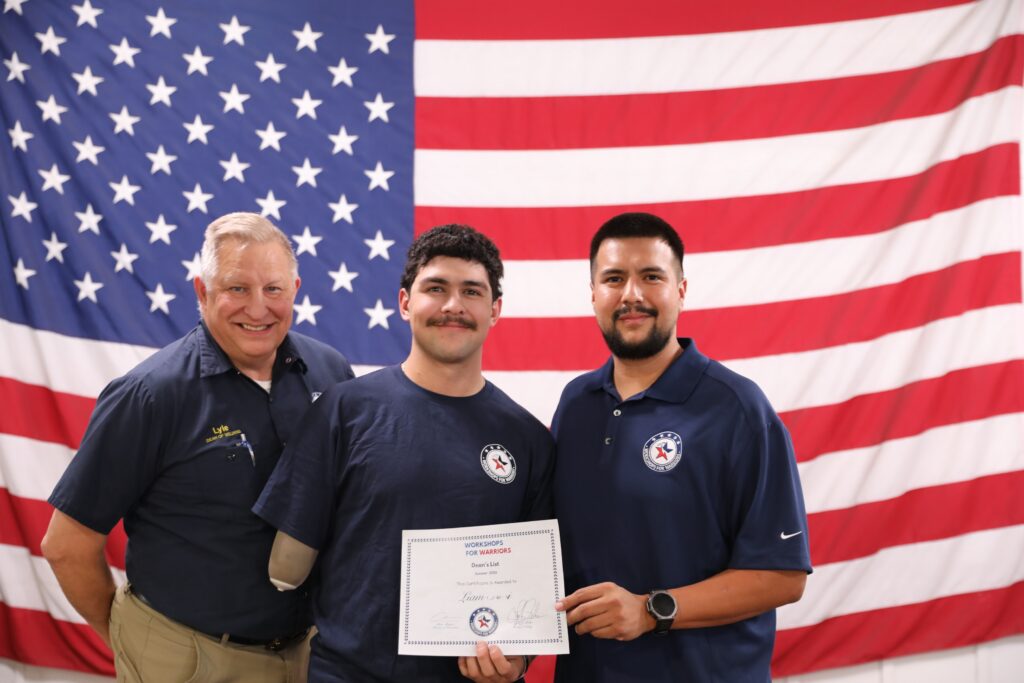
Now nearing graduation, Liam is setting his sights on structural steel or shipbuilding — two industries that are actively hiring skilled welders and where San Diego’s waterfront economy offers real opportunity. He wants to stay in Southern California, build experience, and see where the work takes him.
He’s clear about what Workshops for Warriors made possible — and clear about what he’d tell a fellow veteran standing at the same crossroads he once faced.
“The slogan of rebuilding American manufacturing one veteran at a time is very true,” he says. “From teaching veterans how to weld to trying to place them in manufacturing careers, they’ve been about it since day one.”
For veterans navigating the uncertain terrain between military service and civilian careers, Liam’s story is a reminder that the path forward doesn’t have to look like anything that came before it. Sometimes it starts with a spark, a piece of metal, and the stubborn certainty that you can figure it out.